 Hyperlock
 yield protocol in withdraw-only mode
Hyperlock's original design offered boosted rewards for staking Thruster liquidity-provider positions. It was a yield and metagovernance protocol on Blast, and its application now focuses on withdrawals from existing positions. Metagovernance meant coordinating influence over another protocol's incentive decisions. The shift to withdraw-only operation followed Thruster's closure announcement. Its earlier design connected liquidity rewards, pooled voting power, and token-based participation. The application distinguishes liquidity-provider positions, staked hyperTHRUST, and liquidity positions involving hyperTHRUST, alongside yield and points views.
Thruster liquidity beneath the yield layer
Thruster supplied the exchange and liquidity pools around which the protocol developed, while Blast supplied the network context for that activity. The exchange's concentrated liquidity automated market maker supported liquidity within selected price ranges. The additional protocol layer sought to coordinate incentives around that liquidity. A liquidity provider, or LP, supplied assets to exchange pools; the governance design concerned incentives directed toward those pools. Those roles connected trading liquidity with decisions about how the system encouraged its provision.
Liquidity rewards and the early points program
The original LP route let users stake Thruster LP tokens on Hyperlock for boosted rewards. Its purpose was to improve the incentives available to liquidity providers through pooled governance influence. The original design called for aggregating veTHRUST, Thruster's vote-escrowed governance token.
The early points plan distinguished BLAST, THRUST, and HYPER points during the system's initial incentive phase.
The points program added participation incentives alongside the project's yield proposition. The February 8, 2024 introduction described a prospective token and governance system, so its launch-era benefits require that historical context. A points label and a token distribution describe different things; the former alone does not specify a conversion amount or an available claim.
How did the governance and token components fit together?
The design connected pooled veTHRUST influence with liquidity incentives, while HYPER governance participation and hyperTHRUST represented different ways to participate in that system.
Pooled influence over liquidity incentives
veTHRUST connected the protocol to Thruster's governance structure. Aggregating it was intended to concentrate voting influence that would otherwise sit across separate holders. The proposed liquidity marketplace connected the DAO's Thruster governance power with protocols purchasing incentives to attract liquidity. A protocol seeking liquidity and an LP supplying it therefore occupied different sides of the same arrangement. One wanted incentives directed toward its pool, while the other sought rewards for providing liquidity there.
Separate roles for HYPER and hyperTHRUST
HYPER governance participation concerned decisions over the incentive system. hyperTHRUST belonged to the THRUST participation route. Similar names did not make their roles interchangeable.
HYPER governance participation
The historical design gave HYPER lockers influence over THRUST and HYPER emissions, meaning token rewards distributed through the incentive system. The legacy governance route involved locking HYPER to participate in voting. Its described voting scope included protocol governance, treasury decisions, and Thruster gauges, which directed pool incentives. The legacy product description also offered weekly USDC rewards for delegating votes through markets such as Hidden Hand.
THRUST deposits and hyperTHRUST positions
The legacy THRUST route used THRUST deposits to mint hyperTHRUST. The legacy THRUST participation model assigned stakers 24.5% of the THRUST revenue that LPs generated on the protocol. That percentage applied to the LP-generated THRUST revenue stream, so it did not express a fixed annual return on deposited assets. Minting and revenue sharing described the earlier earning model, while the current application centers on existing positions.
The Aura DAO connection
Aura DAO was central to the project's development background and proposed franchise arrangement. The February 8, 2024 introduction made the planned Blast mainnet launch conditional on Aura governance approval. Planned benefits for Aura included a share of HYPER supply streamed over three years, incentives for HYPER/AURA v3 farms on Thruster, protocol-fee sharing, and shared development resources. The plan treated the supply stream to Aura DAO and a proposed airdrop as separate allocations. These were launch-stage commitments, distinct from a confirmation of completed distributions or a current claim opportunity.
Existing position views in the application
The withdrawal-focused application lists staked hyperTHRUST separately from hyperTHRUST LPs. These labels distinguish staking the token from providing liquidity involving it, so they describe different relationships to the same token. The interface also lists LPs, yield positions, and points positions. A position category helps identify the relevant activity; it does not itself show an account balance or specify the terms for realizing a reward.
| Application view | Position grouping | Interpretation limit |
|---|---|---|
| LPs | Liquidity-provider positions | Listed separately from hyperTHRUST LPs |
| Staked hyperTHRUST | hyperTHRUST staking | Distinct from the hyperTHRUST liquidity view |
| hyperTHRUST LPs | Liquidity positions involving hyperTHRUST | Distinct from staking the token |
| Yield positions | Positions in the yield view | The label does not promise an ongoing return |
| Points positions | Positions in the points view | The label does not establish a token payout |
| These views appear within a withdraw-only application; their names do not confirm an account balance. | ||
What does withdraw-only mode mean for existing positions?
Withdraw-only mode makes exits from existing positions the application's purpose, replacing the earlier emphasis on adding liquidity and earning incentives. Hyperlock announced a transition to withdraw-only mode following Thruster's closure announcement. The notice asks users to withdraw existing positions. That operating change takes precedence over the deposit-oriented language in older product descriptions. Historical references to earning, locking, or minting explain the original model; they do not establish that those entry routes remain available.
The notice does not specify a withdrawal deadline, a processing duration, or a universal redemption amount. It therefore cannot supply those terms for an individual position.
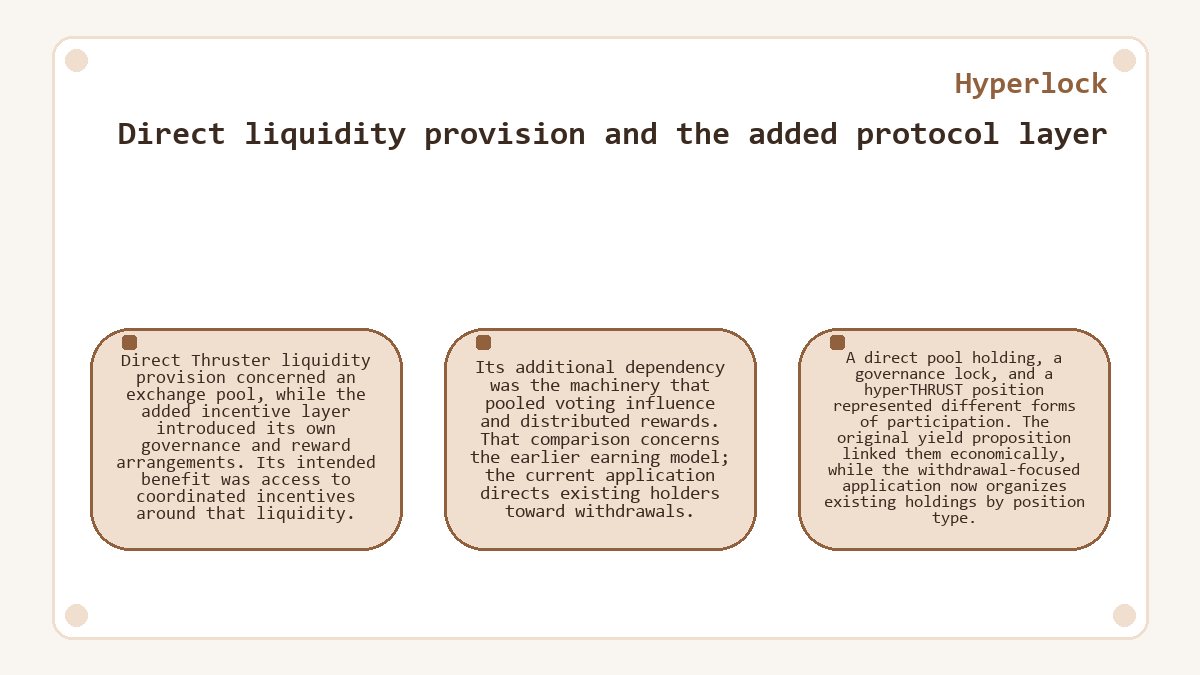
Direct liquidity provision and the added protocol layer
Direct Thruster liquidity provision concerned an exchange pool, while the added incentive layer introduced its own governance and reward arrangements. Its intended benefit was access to coordinated incentives around that liquidity. Its additional dependency was the machinery that pooled voting influence and distributed rewards. That comparison concerns the earlier earning model; the current application directs existing holders toward withdrawals.
A direct pool holding, a governance lock, and a hyperTHRUST position represented different forms of participation. The original yield proposition linked them economically, while the withdrawal-focused application now organizes existing holdings by position type.
Worth knowing
Did LPs have to lock THRUST to access the proposed yield boost?
The original LP design offered boosted yields without requiring liquidity providers to lock THRUST. That arrangement differed from the token-locking roles described for governance and fee participation, and it belonged to the protocol's earlier incentive model.
What lock period did HYPER governance use?
The legacy product description specified a 16-week HYPER lock for voting participation. That period concerned the HYPER governance route; it was not a stated lock period for every LP or hyperTHRUST position and does not determine current exit conditions.
Who was the intended recipient of the Aura-related HYPER airdrop?
The February 8, 2024 introduction identified vlAURA holders as the intended recipients of a HYPER airdrop. That holder allocation was separate from the proposed supply stream to Aura DAO. The launch-stage announcement does not establish an open airdrop claim today.
Why does the application ask for an account connection?
The application asks for an account connection to display that account's positions. Its disconnected view does not establish whether a particular account holds liquidity, staked hyperTHRUST, or another listed position.
Does the withdrawal notice report a security exploit?
The withdrawal notice attributes the operating change to Thruster's closure announcement and does not report an exploit. That statement identifies the announced reason for the change; it does not provide a security assessment of every contract or position.