 Hyperlock
's early design for LP yield and voting power
Hyperlock's early design distinguished boosted rewards for Thruster liquidity providers (LPs) from HYPER stakers' influence over token emissions. The proposal centered on pooled veTHRUST, Thruster's vote-escrowed governance token, within the Blast ecosystem. Earning liquidity rewards and directing their allocation represented different forms of participation. The design assigned THRUST lockers another benefit: a share of protocol fees. These distinctions concerned the original incentive model; the application later announced withdraw-only operation following Thruster's closure announcement. The comparison turns on what each contribution was intended to earn, which decisions it could influence, and how the underlying exchange supported those benefits.
Liquidity and voting power met through incentive allocation
Thruster supplied the liquidity pools, while the proposed aggregation of veTHRUST connected governance influence with incentives for those pools. A liquidity provider contributed assets to exchange liquidity. In the proposal, governance participants would influence the rewards intended to attract those contributions.
The February 8, 2024 announcement, Introducing Hyperlock, set out this early model. Its proposed aggregation gave the protocol a collective role in Thruster governance.
LP yield as compensation for liquidity provision
The intended LP benefit was boosted yield from participating in Thruster liquidity through the additional protocol layer. The proposal assigned control over THRUST and HYPER emissions to HYPER stakers.
The proposed boost linked the LP's reward opportunity to governance power pooled elsewhere in the system. Liquidity provision and HYPER staking served different roles, even when participants' economic interests overlapped.
What did HYPER stakers control in the early model?
HYPER stakers would direct THRUST and HYPER emissions in the early design, with control focused on the distribution of token incentives.
Thruster-side governance influence
The early design proposed aggregating veTHRUST to consolidate influence over Thruster incentives. Metagovernance described this coordination of influence over another protocol. Here, the outside protocol was Thruster, and the underlying voting instrument was veTHRUST.
Control over token emissions
Emissions meant the token rewards that the design proposed distributing. Including both THRUST and HYPER connected the staking role with incentives from the underlying exchange and the additional protocol layer.
THRUST lockers' share of protocol fees
The early model assigned THRUST lockers a share of protocol fees, introducing an income source separate from the LP yield benefit. Fee sharing concerned revenue that the protocol was intended to collect. Emission control concerned the distribution of token incentives.
Protocols could purchase influence to attract liquidity
The proposed liquidity marketplace gave protocols a purchasing role alongside the LPs that sought rewards and the stakers that directed emissions. A protocol seeking liquidity for its token could purchase incentive influence.
On the buying side, the relevant input was the resources committed to obtaining incentive influence. The intended benefit was support for attracting liquidity. On the LP side, the contribution was liquidity itself, and the intended benefit was boosted yield.
A protocol's demand for liquidity could create demand for governance influence. That influence could help direct the rewards that encouraged LP participation.
The Hyperlock DAO was intended to control the pooled Thruster governance power that the design proposed making available to incentive buyers.
An LP reward increase without a voting mandate
In this hypothetical comparison, a reader's Thruster LP rewards increase while the holding remains an LP position. The reader wants to understand whether greater compensation also means greater authority over THRUST and HYPER emissions.
The early model attached the reward benefit to liquidity participation. A higher reward would change what that LP position earned. The design assigned emission control to HYPER stakers, so the reward increase alone would not establish that the LP position had gained that control.
Compensation and emission control would concern different contributions, even for the same participant.
If the priority changed from earning liquidity rewards to influencing allocation, the relevant comparison would shift to HYPER staking. That conclusion concerns the original role design. It does not supply a current staking route during withdraw-only operation.
Reward size and allocation authority used different measures
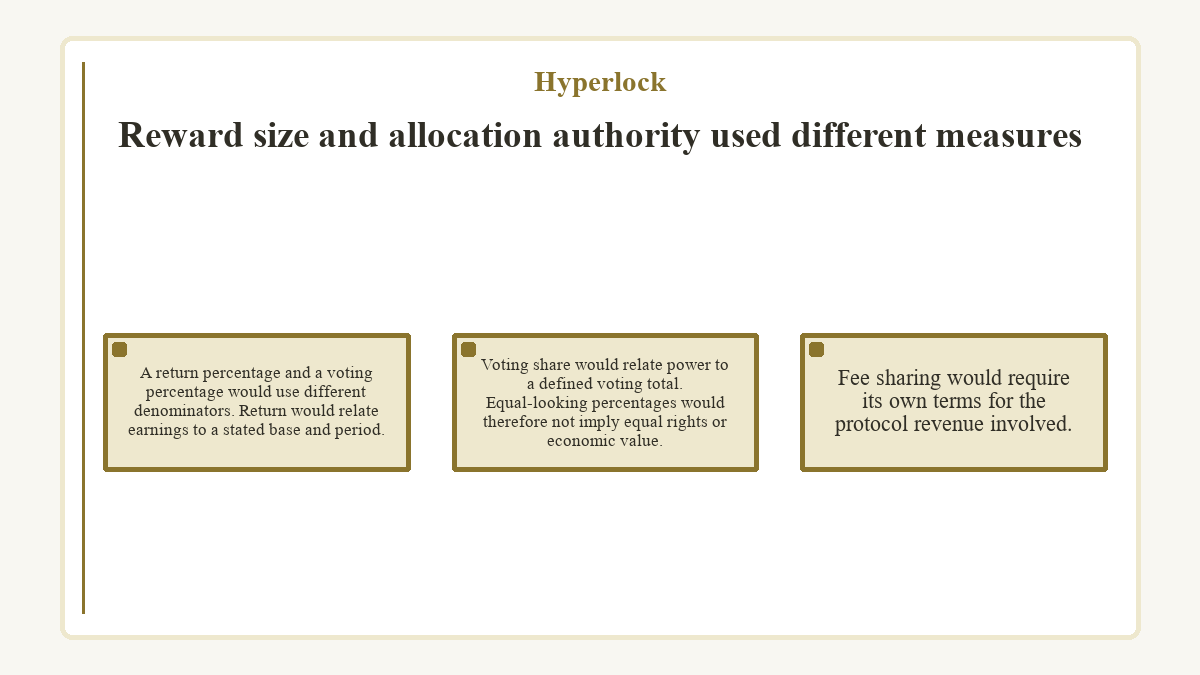
A return percentage and a voting percentage would use different denominators. Return would relate earnings to a stated base and period. Voting share would relate power to a defined voting total. Equal-looking percentages would therefore not imply equal rights or economic value. Fee sharing would require its own terms for the protocol revenue involved.
Thruster and Blast defined the model's operating context
The proposed benefits used Thruster's exchange infrastructure and veTHRUST system within Blast, making Thruster an operating dependency of the original model.
Concentrated liquidity
Thruster's core design centered on a concentrated-liquidity automated market maker with native yield integrations. That infrastructure supported trading liquidity. The additional governance layer sought to improve the incentives around liquidity provision.
Blast deployment
The proposal placed both the exchange relationship and the governance aggregation in the Blast ecosystem.
Withdraw-only operation changed the participation question
The application announced a withdraw-only state following Thruster's closure announcement. Its notice asked holders to withdraw existing positions. The early allocation model therefore describes historical participation roles, not an invitation to start a new yield or governance position.
The application distinguished LP positions, staked hyperTHRUST, and hyperTHRUST LP positions. Those categories concerned different holdings, so the relevant next question became the withdrawal conditions for the actual position. Earlier descriptions of boosted yield or emission control did not specify the exit method, timing, or proceeds for every holding.
Common questions
-
Did the early design promise a fixed LP yield boost?
- The February 8, 2024 introduction described boosted LP yields without quoting a fixed boost percentage. It identified an intended benefit, but it did not provide a formula that could turn that description into a payout estimate for a particular position.
-
Was a specific percentage assigned to THRUST lockers' fee income?
- Hyperlock's February 8, 2024 introduction assigned THRUST lockers a share of protocol fees without stating that share as a percentage. The applicable fee-sharing terms would determine the amount attributable to that role.
-
Could buying incentive influence guarantee higher trading volume?
- Purchasing incentive influence did not establish a guaranteed trading-volume outcome. The intended benefit was attracting liquidity. The early announcement treated increased trading volume as an expected effect of the broader design, rather than reporting a measured outcome from a particular incentive purchase.
-
Where did planned Thruster frontend integration fit into the design?
- Planned direct frontend integration concerned access to Hyperlock products through Thruster's interface. It addressed how users would encounter the products, while the LP, HYPER-staking, and THRUST-locking roles defined their proposed benefits. The February 8, 2024 announcement presented that integration as forthcoming.
-
Did Aura DAO have to approve Hyperlock's early launch plan?
- Aura DAO approval was a stated condition of the potential Blast mainnet launch in the February 8, 2024 introduction. That was a condition of the early launch proposal, not a statement that the same approval remained pending later.