 Hyperlock
 hyperTHRUST was minted from THRUST deposits on Blast
Hyperlock hyperTHRUST was minted when users deposited THRUST into the protocol's Blast-based system. Minting created the token, while staking or liquidity provision determined how a holding participated in the reward model. The application later announced a move to withdraw-only operation following Thruster's closure announcement. Existing holdings could therefore involve the minted token, a stake, or a liquidity position. These forms required different interpretations, especially when considering a return to THRUST.
What's inside
THRUST deposits created a different token holding
The earlier deposit route used THRUST as its input and issued hyperTHRUST as its output. An amount expressed in hyperTHRUST could not automatically describe an amount of THRUST.
Reinvesting earned THRUST rewards meant depositing that income to mint hyperTHRUST. Earnings from the resulting position depended on the reward arrangement that covered that holding.
Staking and liquidity provision described different holdings
A hyperTHRUST stake committed the token to a staking arrangement; liquidity provision contributed it to a pool position. The application listed staked hyperTHRUST and hyperTHRUST LPs separately. LP meant liquidity provider.
An LP amount represented participation in a pool, whose assets and their amounts determined the holding's composition. A staked-token amount referred to the staking arrangement's units. Reading either number as a directly available THRUST balance would erase the asset distinction.
A compounder introduced another set of accounting units
The historical compounder added share accounting to the interpretation of a hyperTHRUST holding. Shares represented participation in the vault, while the underlying token described the asset associated with those shares. Their quantities could differ.
A successful compounder redemption dated January 4, 2025, used hyperTHRUST as its output asset. Its record distinguished the staked-token shares that left circulation from the hyperTHRUST that the account received.
Compounder share accounting belonged to that historical vault. Other staking arrangements required their own token units and exit terms.
What did the historical 24.5% revenue allocation measure?
The earlier product description allocated stakers 24.5% of the THRUST revenue generated by LPs on Hyperlock. That percentage described a revenue allocation to stakers collectively. It did not describe annual interest on each deposit or a payment calculated from each account's full balance.
An individual rate of return required the actual distribution to that account and the value of its position over the relevant period. The published allocation alone could not determine those figures. It also could not establish a remaining claimable balance after the application announced its move to withdraw-only operation.
A minting ratio and a market price answered different questions
A minting ratio expressed output token units relative to deposited token units, while a market price expressed exchange value. Even an established issuance ratio would not prove an equal resale value. A historical deposit amount therefore needed its actual minting terms or issuance record. The word minting alone supplied neither an exact conversion ratio nor the terms for converting hyperTHRUST back into THRUST.
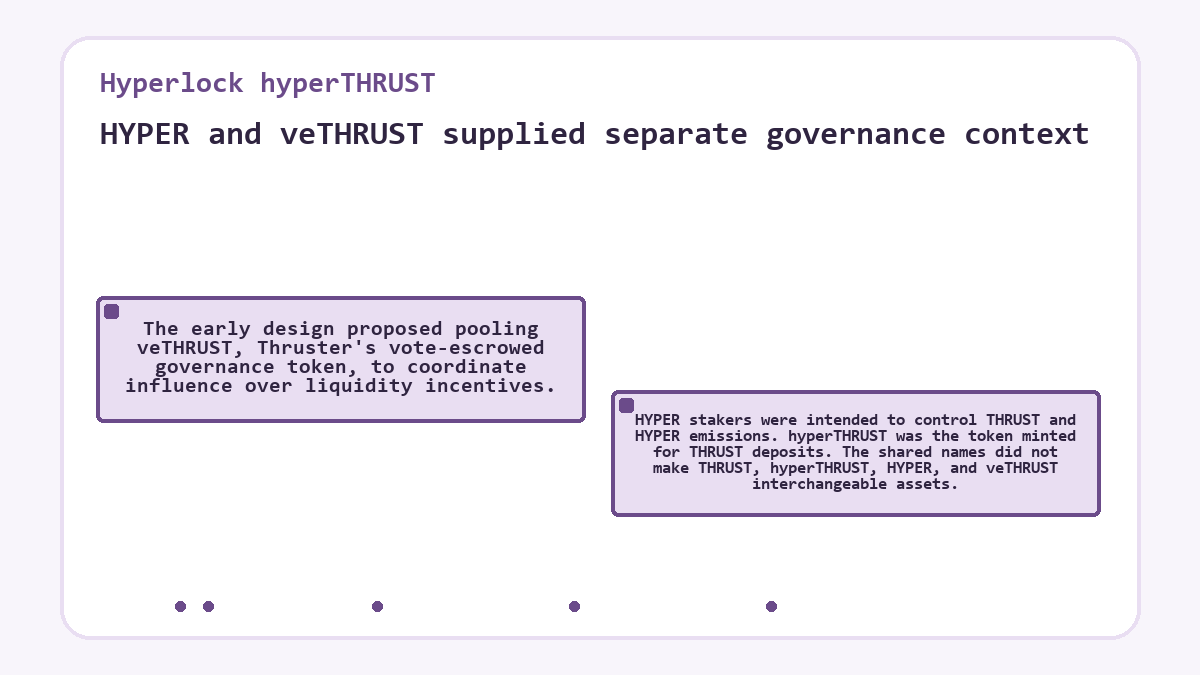
HYPER and veTHRUST supplied separate governance context
The early design proposed pooling veTHRUST, Thruster's vote-escrowed governance token, to coordinate influence over liquidity incentives. HYPER stakers were intended to control THRUST and HYPER emissions. hyperTHRUST was the token minted for THRUST deposits. The shared names did not make THRUST, hyperTHRUST, HYPER, and veTHRUST interchangeable assets.
A completed redemption could leave the return to THRUST unfinished
Consider a hypothetical account holding shares in the historical compounder on Blast and assessing whether redemption would reverse its THRUST deposit. Before committing, the holder needed to distinguish the share input from the hyperTHRUST output. The aim of recovering THRUST therefore extended beyond redeeming the compounder shares.
Authorizing or submitting the redemption would not establish its completion. Suppose the successful transaction record showed the share burn and the transfer of hyperTHRUST to the account. Those recorded changes would establish the completed redemption in this case. They would not establish a THRUST payment.
A follow-up check would compare the recorded transfer with the account's corresponding hyperTHRUST balance change. A match would support receipt of the output token. Obtaining THRUST would still require a separate, applicable conversion route. Completing the compounder redemption would not establish that route's availability or exchange terms.
The withdraw-only notice changed the context of deposit instructions
The application's withdrawal notice followed Thruster's closure announcement and asked holders to withdraw existing positions. Earlier minting and reinvestment descriptions explained the protocol's historical reward model. They did not establish continued access to new THRUST deposits after that notice.
For an existing holding, the next decision concerned its precise form: hyperTHRUST tokens, a stake, or liquidity participation involving hyperTHRUST. A compounder position also required its own share units. Keeping the position and returned asset distinct avoided treating the end of one arrangement as a completed return to the original THRUST balance.
Questions and answers
-
Did the HYPER governance lock also set a hyperTHRUST staking term?
- The published 16-week lock concerned HYPER governance participation. HYPER and hyperTHRUST were different tokens with different roles. That governance lock period did not establish the duration or exit conditions of a hyperTHRUST stake.
-
Were weekly USDC vote incentives the same as hyperTHRUST staker revenue?
- Weekly USDC incentives belonged to the described HYPER vote-delegation activity. The hyperTHRUST revenue description concerned THRUST revenue generated by LPs on Hyperlock. These reward arrangements used different assets and participation conditions, so the governance schedule did not establish a hyperTHRUST payment schedule.
-
How did a hyperTHRUST transfer from another holder differ from the original THRUST deposit?
- A transfer from another holder moved existing hyperTHRUST, while minting created tokens through the THRUST deposit route. Receiving such a transfer therefore did not establish that its recipient made the original THRUST deposit.